At the opening of the novel
The Emergency Broadcast
A radio announcement reports that the United States government has been suspended outside the District of Columbia and that local authorities must take over. Another broadcast says an Oakland hospitalization center has been abandoned, while an ominous 1947 warning about a deadly virus frames the crisis as a disaster long imaginable but never expected.
The first days of the outbreak
The Rattlesnake Bite
While alone in the [Black Creek Area](entity:location-recall-location-black-creek-area-20369b253389), graduate student [Isherwood Williams](entity:character-recall-character-isherwood-williams-350d459f7ec5) is bitten by a rattlesnake. He binds his wrist, treats the wound with his snake-bite kit, and tries to manage the pain while dismissing the danger as a temporary nuisance.
That night and the following day
The Fever Takes Hold
Isherwood develops chills, fever, coughing, and a measles-like rash. Two frightened men enter his cabin, see that he is ill, and flee without helping him; traffic passes nearby but no one stops.
A few days after the bite
Survival by Collision
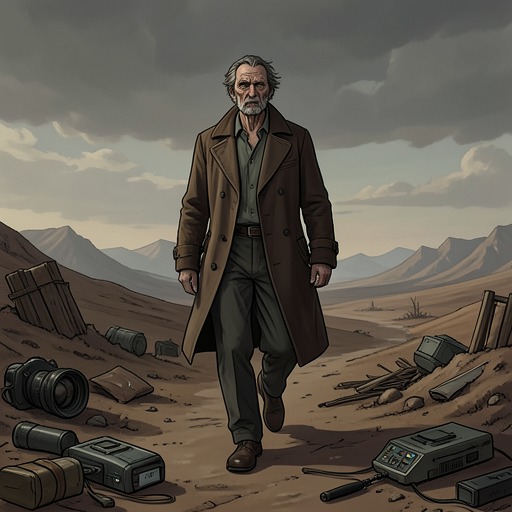
The illness recedes almost as abruptly as it began, and Isherwood realizes that he may have contracted the new disease and survived because it counteracted the rattlesnake venom. He leaves the cabin carrying his notebooks, camera, and old hammer, with no idea that the epidemic has emptied the world around him.
Soon after Isherwood leaves the cabin
The Empty Ranch
At Johnson's ranch, Isherwood finds the store unattended and takes gasoline, leaving a check and a note. The absent ranchers, the lack of fishermen, and a collie barking near the silent power-house all deepen his unease, though the machinery still runs.
The same afternoon
Hutsonville Falls Silent
In [Hutsonville](entity:location-recall-location-hutsonville-4c4eecc7fbfb), Isherwood finds an unattended town, a body by the road, and only animals moving through the streets. He breaks into a pool-room to read a newspaper whose headline announces an acute crisis: a new disease has spread across the country and killed a large share of the population.
The day after reaching Hutsonville
The Last Newspaper
The paper describes a rapidly spreading, probably airborne disease that has overwhelmed cities and defeated attempts at quarantine. It also records the desperate work of doctors, nurses, and authorities, including the rule requiring immediate mass burial, before news services and public order begin to fail.
The following days
No One Answers
Isherwood searches the town by car, sounding the horn, but finds only scattered dogs, cats, chickens, and a cow. In a large house he discovers a radio that still receives power but no broadcasts, making the silence feel less like a temporary evacuation than the end of communication.
A few days after the outbreak
The Search for His Family
Isherwood drives across the empty highways toward the [San Francisco Bay Area](entity:location-recall-location-san-francisco-bay-ar-5e5db13b0ee9), passing wrecked cars, dead people, and a coyote moving freely along the road. The city lights and traffic signals still function, but the living systems that once depended on people are already beginning to fail.
On reaching San Lupo Drive
The Empty Family Home
Isherwood returns to his parents' house and finds it intact but abandoned, with both beds unmade and no message explaining where his parents went. The moving clock and humming refrigerator briefly make the house seem inhabited; their ordinary sounds instead sharpen his realization that his family is gone.
That evening
A Spectator's Purpose
From the porch, Isherwood watches the lights of the Bay Area and wonders how long civilization's machinery can continue without its makers. He rejects despair for the moment, deciding that his training as an observer gives him a reason to stay alive and witness what happens to the world without humanity.
The next morning
The First Search for Survivors
Isherwood searches his neighborhood and then drives through the city, calling for anyone who may still be alive. His first signal leads him to [Mr. Barlow](entity:character-recall-character-mr-barlow-a8c6ffc98558), an alcoholic survivor who is too shattered by the catastrophe to accept help and dies soon afterward.
During the first days of searching
The Dangerous Couple
A flamboyant man and a woman answer Isherwood's horn and make their interest in him feel threatening. He leaves rather than risk a confrontation, recognizing that survival has not made every survivor kind or safe.
During the same search
The Flight of the Girl
Isherwood glimpses a teenage girl, but she runs from him and disappears through a fence. He understands that her caution may be an earned defense in a world where a young woman cannot assume that a stranger means well.
Later in the first search
The Hoarding Hermit
Isherwood meets a former hardware-store clerk who has become an isolated hoarder, surrounding himself with supplies and useless possessions. The man's fear that he survived because he is sinful reveals how the disaster can distort a person's mind as surely as hunger or disease can destroy a body.
The end of Isherwood's first day searching
The Bridge and the Dead Drunk
Isherwood crosses the empty [Bay Bridge](entity:location-recall-location-bay-bridge-a56847e8a15e) and sees a parked coupé whose owner may have vanished over the railing. He returns to [Mr. Barlow](entity:character-recall-character-mr-barlow-a8c6ffc98558), now dead, wraps him in blankets, and gives him a makeshift burial inside a car rather than leave his body to scavengers.
After the first encounters with survivors
The Secondary Kill
Isherwood concludes that the epidemic is only the first danger: survivors may die from despair, violence, accidents, untreated illness, or the loss of skills and social support. The few people he has met do not persuade him to join them, and he begins to understand that the disaster has selected no obvious class of worthy survivors.
The morning after the first search
Princess Chooses Isherwood
As Isherwood prepares to leave the Bay Area, a beagle-like dog persistently courts his attention until he pats her and feeds her. He accepts that she has adopted him, names her [Princess](entity:character-recall-character-princess-5bee508041fa), and finds that her companionship softens his isolation.
During the journey east
The Desert Declaration
Crossing the [Mojave Desert](entity:location-recall-location-5487bb151be1), Isherwood grows fearful of a breakdown and loads his station wagon with water, supplies, and a police motorcycle as backup. When [Princess](entity:character-recall-character-princess-5bee508041fa) bolts after a rabbit and then returns, his panic breaks; he abandons the motorcycle and decides to live without letting fear govern every choice.
During the first weeks on the road
Learning to Hunt
In Tennessee, Isherwood shoots a cow and calf for food, a bloody task that leaves him shaken but also moves him beyond merely opening cans. He begins gathering produce and hunting animals himself, learning that survival requires participation in the living world rather than dependence on the vanished economy.
During Isherwood's eastward journey
The Arkansas Survivors
In [Arkansas](entity:location-recall-location-d53eeadec6d7), Isherwood finds a Black man, a woman, and a boy cultivating a garden and keeping animals. Their modest, land-based life is more self-sustaining than his scavenging, and he recognizes that they have adapted to the new conditions better than many urban survivors.
Later in the first year after the disaster
New York's Quiet Survivors
In [New York City](entity:location-recall-location-new-york-city-65df0a129d4c), Isherwood searches an empty [Manhattan](entity:location-recall-location-5e470c74b89c) and sees the cathedral, [Central Park](entity:location-recall-location-0d5dd0e00cc4), and Fifth Avenue stripped of their former crowds. On [Riverside Drive](entity:location-recall-location-f52772f1df9b) he meets [Milt Abrams](entity:character-recall-character-milt-abrams-0ce8303fb329) and [Ann](entity:character-recall-character-ann-1162d7c1082b), who have made a narrow, comfortable life but lack the mobility and adaptability to thrive beyond their small urban enclave.
After the meeting in New York
The Return to San Lupo
Isherwood leaves Milt and [Ann](entity:character-recall-character-ann-1162d7c1082b) and drives back across the country, finally returning to [San Lupo Drive](entity:location-recall-location-san-lupo-drive-e75eb4cf152b). The house remains empty, and he accepts that his parents will not come home, even as he resumes the familiar routines that make solitary life bearable.
Several months after the disaster
The Lights Go Out
The electrical system that has outlasted its operators begins to falter as unattended generator governors fail. Isherwood watches the Bay Area lights dim and die, mourning the loss of a system whose carefully coordinated machinery had kept working long after its human stewards were gone.
The first autumn after the disaster
A New Kind of Quiet
With electricity gone and refrigeration failing, Isherwood adjusts to a world in which stored food will not remain fresh indefinitely. Rain begins to erode roads and drains, while wild plants spread through neglected gardens; he stops treating these changes as damage and sees them as nature reclaiming human arrangements.
That autumn
The Smoke on the Mountain
After rain clears the air, Isherwood sees a thin column of smoke near [Mount Tamalpais](entity:location-recall-location-mount-tamalpais-340a7f29eca5) and suspects another survivor is nearby. His old shyness makes him drive in the opposite direction, but when a light appears again after dark, he returns to investigate.
That evening
Isherwood Meets Em
[Princess](entity:character-recall-character-princess-5bee508041fa) rushes toward a lit house, forcing Isherwood to approach the stranger he had nearly avoided. A woman named [Emma](entity:character-recall-character-emma-0b5c09f9ac66) welcomes him with warmth, and the two share food, stories, and the recognition that each has endured the same vast loneliness.
The night Isherwood meets Emma
A Shared New Life
Isherwood and [Emma](entity:character-recall-character-emma-0b5c09f9ac66), whom he comes to call [Em](entity:character-recall-character-em-c28fd008e90d), become lovers and begin building a life together. Their intimacy is not only physical: their shared meal and candid conversation restore a human bond that Isherwood had feared he could no longer enter.
The first winter after the disaster
The First Child
[Em](entity:character-recall-character-em-c28fd008e90d) becomes pregnant, and the couple face the risks of childbirth without doctors or hospitals. She wants the baby as an expression of life rather than as a duty to a grand historical project, and her courage helps Isherwood accept the risk.
At the winter solstice after the first year
The Year One
Isherwood and [Em](entity:character-recall-character-em-c28fd008e90d) decide that the solstice will mark the beginning of their new calendar rather than trying to reconstruct the old one. They establish a [Year One](entity:expression-recall-expression-year-one-31788900f391) and begin the custom of carving each year's number into the rock, preserving a shared measure of time and a record for their descendants.
The first full year after the disaster
The Year of the Baby
Isherwood carves the numeral 1 into the year-marking stone while [Em](entity:character-recall-character-em-c28fd008e90d) nurses their first child, whom they name John. Their ceremony turns survival into history, and the year's personal name reflects the new family's central joy.
The second year
The Failed Garden
Isherwood tries to grow vegetables, but old seeds, pests, rabbits, deer, and crows overwhelm his garden. He saves some seed for the future, learning that cultivation without the surrounding human community is much more difficult than he had imagined.
The second year
Mary and the Year of Ezra
[Em](entity:character-recall-character-em-c28fd008e90d) gives birth to [Mary](entity:character-recall-character-mary-ea333e3cde9f), and the family later receives a wanderer named [Ezra](entity:character-recall-character-ezra-ac1e5ebef93c), whose ease with people makes him a welcome presence. When Ezra moves on, the community names the year in his honor, recognizing the value of companionship even as it cannot keep him.
The fourth year
The Coming of Ezra's Family
[Ezra](entity:character-recall-character-ezra-ac1e5ebef93c) returns with [Molly](entity:character-recall-character-molly-578702d2db0d), [Jean](entity:character-recall-character-jean-3b22ff98bd2e), a boy named [Ralph](entity:character-recall-character-ralph-5eacffcc40e0), and [Evie](entity:character-recall-character-evie-fa6b246e6974), a traumatized girl he found living alone. His arrival enlarges the household and begins the growth of a small community, while Evie's condition becomes a lasting challenge to the group's ideas about care and the future.
The fourth and fifth years
The Tribe Takes Shape
Isherwood and [Ezra](entity:character-recall-character-ezra-ac1e5ebef93c) find [George](entity:character-recall-character-george-4ccc9776b2d0) and [Maurine](entity:character-recall-character-maurine-dd10e05f7ff9), and the survivors gradually form a household of adults and children. They begin calling themselves the Tribe, relying on George's practical carpentry, Ezra's social gift, and [Em](entity:character-recall-character-em-c28fd008e90d)'s steadiness as the population grows.
The sixth year
The Bad Year
Drought leaves the cattle hungry, and a plague of grasshoppers strips vegetation from the land before dying in great numbers. The cattle also perish, the country appears ruined, and the adults lose confidence until rain brings new green growth and restores their hope.
The seventh year
The Year of the Lions
As the cattle herds collapse, mountain lions increasingly approach the settlement and kill several dogs. Isherwood is mauled when he misses a shot, leaving him with a lasting limp and marking the dangers of living beyond civilization's protections.
The eighth year
The End of Church Services
The adults try holding Sunday services to offer the children unity and comfort, but their different beliefs and Isherwood's skepticism make the experiment feel hollow. He ends the formal gatherings by suggesting that each person continue in silent prayer in their own way.
The ninth year
The Return of the Common Cold
A passing wanderer brings a cold to the Tribe, ending years in which common infections had seemed to disappear. Isherwood explains that epidemics had been interrupted when populations collapsed, but the outbreak reminds everyone that contact can revive old dangers.
The ninth year
The Year of the Deaths
Three children die after apparently ingesting poison in an abandoned house. The losses include one of Isherwood and [Em](entity:character-recall-character-em-c28fd008e90d)'s children, and the year becomes a painful reminder that civilization's remnants can still harm those who inherit them.
The tenth year
The Fishing Years
The Tribe discovers that the Bay is rich with striped bass and makes fishing a shared source of food and pleasure. The children also take increasing interest in practical activities, though Isherwood remains concerned that knowledge and skills are not being passed on systematically.
The eleventh year
The Wood-Carving Year
The children develop a craze for carving figures from soft wood, and Isherwood supports the activity as a sign of creative life returning. The group names the year for the carvings, while Isherwood privately recognizes that the younger generation's culture is diverging from the one he remembers.
The sixteenth year
The First Marriage
[Mary](entity:character-recall-character-mary-ea333e3cde9f) and [Ralph](entity:character-recall-character-ralph-5eacffcc40e0) marry, and their union is treated as a practical community responsibility rather than a romance. Isherwood resists an elaborate imitation of an old wedding and has [Ezra](entity:character-recall-character-ezra-ac1e5ebef93c) give a simple statement about the couple's responsibilities to the group.
The seventeenth year
The House Collapses
A nearby house suddenly falls after termites undermine its supports. The children remember the dramatic collapse as the defining event of the year, while the adults see how quickly neglected buildings are becoming unsafe.
The twenty-first year
The Year of Joey's Reading
[Joey](entity:character-recall-character-joey-c35b090b613f), one of Isherwood and [Em](entity:character-recall-character-em-c28fd008e90d)'s twins, reveals that he can read fluently and for pleasure. Isherwood sees in his youngest son the rare intellectual spark that might help humanity recover knowledge, and begins to invest his hopes in him.
New Year's Day in Year 22
The Water Supply Fails
The household faucets begin to run only as a trickle, and Isherwood learns that several homes are affected. He leads [Ezra](entity:character-recall-character-ezra-ac1e5ebef93c) and [George](entity:character-recall-character-george-4ccc9776b2d0) to the reservoir, where they find it nearly empty, forcing the community to confront its dependence on infrastructure it has never maintained.
The first day of the water crisis
A Community Turns to Springs
The Tribe hauls water from nearby springs and streams, then begins digging a well and building outhouses. The first burst of effort fades as people return to fishing and hunting, exposing the gap between Isherwood's long-range plans and the group's preference for immediate comfort.
The evening of the water crisis
The Expedition Is Proposed
After the community's response to the water failure disappoints him, Isherwood argues that the Tribe must do more than scavenge and should learn what is happening elsewhere. The suggestion catches the group's imagination, and [Robert](entity:character-recall-character-robert-dcc9e88f1178) and [Richard](entity:character-recall-character-richard-cc7ee1eeaeeb) are chosen to travel east in search of other communities.
The weeks after the expedition is proposed
The Jeep Is Repaired
Isherwood, [Robert](entity:character-recall-character-robert-dcc9e88f1178), [Richard](entity:character-recall-character-richard-cc7ee1eeaeeb), and [Joey](entity:character-recall-character-joey-c35b090b613f) restore an old jeep using stored parts, fresh oil, a newly prepared battery, and tires salvaged from other vehicles. Joey spots the spare tire they had overlooked, showing the keen observation Isherwood hopes will make him a leader of renewal.
The fourth day after the decision
The Boys Leave for the East
[Robert](entity:character-recall-character-robert-dcc9e88f1178) and [Richard](entity:character-recall-character-richard-cc7ee1eeaeeb) set out in the repaired jeep with supplies, maps, and Isherwood's route advice. Isherwood wants them to find not merely isolated survivors but communities, yet the departure leaves their family members anxious and him torn between hope and fear.
During the months of the expedition
The Tribe's Stagnation
While the boys are away, Isherwood continues teaching and tries to make school meaningful, but most children prefer play and practical skills. He worries that the Tribe has settled into a scavenger life and that the younger generation may lack the knowledge to make its own future.
Later in Year 22
The Boys Return with Charlie
[Robert](entity:character-recall-character-robert-dcc9e88f1178) and [Richard](entity:character-recall-character-richard-cc7ee1eeaeeb) return from their long journey with [Charlie](entity:character-recall-character-charlie-24c3a7bd9408), a powerful and charismatic stranger they met near [Los Angeles](entity:location-recall-location-los-angeles-11eff639bdf5). Their accounts also reveal isolated groups near Los Angeles and [Albuquerque](entity:location-recall-location-albuquerque-ad01fad51a1c), but Isherwood's unease about Charlie begins to overshadow the news of wider human survival.
The first days after the expedition returns
The Other Communities
The boys report that the [People of God](entity:organization-recall-organization-people-of-god-9a334ef087c5) in [Los Angeles](entity:location-recall-location-los-angeles-11eff639bdf5) rejected them and that a community near [Albuquerque](entity:location-recall-location-albuquerque-ad01fad51a1c) lived by Pueblo farming traditions and distrusted outsiders. The journey confirms that survivors exist, but also that groups are becoming culturally isolated and wary of contact.
Soon after Charlie's arrival
Charlie and Evie
[Charlie](entity:character-recall-character-charlie-24c3a7bd9408) quickly wins the younger people's affection and becomes close to [Evie](entity:character-recall-character-evie-fa6b246e6974), whom the Tribe has treated as an untouchable because of her intellectual disability. Isherwood sees the relationship as a threat to the community's assumed rules and fears that Charlie is challenging his authority as well as the taboo around Evie.
The first nights after Charlie arrives
A Hidden Pistol
[Ezra](entity:character-recall-character-ezra-ac1e5ebef93c) discovers that [Charlie](entity:character-recall-character-charlie-24c3a7bd9408) carries a concealed pistol and has altered his clothing to hide it. He describes Charlie as both potentially charming and deeply dangerous, confirming Isherwood's suspicion that the stranger may not accept the Tribe's customs or leadership.
Shortly after the pistol is discovered
The Tribe Confronts Charlie
Isherwood orders [Charlie](entity:character-recall-character-charlie-24c3a7bd9408) to stop pursuing [Evie](entity:character-recall-character-evie-fa6b246e6974), but Charlie refuses to recognize Isherwood's authority and turns the conversation into a contest of power. Isherwood leaves the confrontation humiliated, realizing that his intellectual influence is not the same as enforceable leadership.
The same day as the confrontation
The Disease Revelation
[Ezra](entity:character-recall-character-ezra-ac1e5ebef93c) reveals that [Charlie](entity:character-recall-character-charlie-24c3a7bd9408) boasted of having several sexually transmitted diseases, and the group recognizes that he may also carry other infections. With no doctors and no reliable tests, the Tribe must decide whether the danger is real enough to justify a drastic response.
That evening
The Death Vote
The four older members who deliberate agree that the Tribe cannot safely imprison [Charlie](entity:character-recall-character-charlie-24c3a7bd9408) or rely on a warning. Though Isherwood begins by writing a vote for banishment, he changes it to death; the ballots reveal unanimous support for execution as a measure of collective self-defense.
The day after the vote
Charlie's Execution
The Tribe takes [Charlie](entity:character-recall-character-charlie-24c3a7bd9408) away and executes him, burying him beneath an oak tree. The act establishes the beginnings of collective law, but Isherwood cannot be sure that public safety alone motivated him; he fears that personal jealousy and the struggle for leadership also shaped his decision.
Soon after the execution
Corn Seeds from the Pueblo
Isherwood opens the box of [Pueblo corn seeds](entity:object-recall-object-pueblo-corn-seeds-23ab66b3287b) that [Robert](entity:character-recall-character-robert-dcc9e88f1178) and [Richard](entity:character-recall-character-richard-cc7ee1eeaeeb) brought back and sees a chance to preserve a crop adapted to human care. He shares the seeds with [Joey](entity:character-recall-character-joey-c35b090b613f) and begins planning a trial planting, treating them as a fragile link between the old agricultural world and the future.
Later in Year 22
The Typhoid Outbreak
After the expedition and [Charlie](entity:character-recall-character-charlie-24c3a7bd9408)'s arrival, several members of the Tribe develop a severe illness that Isherwood identifies as likely typhoid. He suspects that Charlie carried the infection and that the primitive sanitation and houseflies helped spread it, but by the time precautions begin, the community has already been exposed.
During the height of the epidemic
The Death of Joey
Isherwood falls gravely ill while caring for [Joey](entity:character-recall-character-joey-c35b090b613f) and [Josey](entity:character-recall-character-josey-aae9d93218aa), and wakes to learn that five children have died, including Joey. His belief that Joey was the [Child of the Blessing](entity:concept-recall-concept-child-of-the-blessing-641d41782fc5) collapses with the boy's death, leaving him to face the possibility that the future will not follow the plan he imagined.
After the survivors recover
The Funeral at Sunrise
The Tribe gathers at the graves of the five children, and [Ezra](entity:character-recall-character-ezra-ac1e5ebef93c) speaks about each child through remembered details rather than promises of an afterlife. The rising sun gives the ceremony a symbol of continuity, while Isherwood accepts the hammer as a source of comfort instead of trying to suppress the group's reverence for it.
In the months after the epidemic
The Hammer Becomes Sacred
Grieving [Joey](entity:character-recall-character-joey-c35b090b613f), Isherwood walks toward the [University Library](entity:location-recall-location-university-library-e2ff13269fc7) and considers throwing away the hammer, which has become a focus of the children's awe. He cannot bring himself to part with it, and recognizes that the object now carries emotional and communal meaning beyond its use as a tool.
Soon after the funeral
School Is Dismissed
Isherwood sees that the children lack both the interest and the circumstances needed to continue his school, and he ends the lessons permanently. Their relief turns to unease when they understand that something important has ended, but he accepts that the old educational project has failed.
The weeks after school closes
The Bow and Arrows
Rather than teach from books, Isherwood makes a simple bow from lemon wood and rawhide and shows the children how to use it. The activity becomes a game, then a craft, and finally a means of hunting; it gives the Tribe a practical skill that will remain usable after ammunition and matches are gone.
Later in Year 22
The First Wild Rabbit
[Walt](entity:character-recall-character-walt-6a18b11bf060) and Weston bring Isherwood a rabbit killed with a wooden arrow, proof that the bow can provide food. He sees the achievement as a small victory for independent skill, though the animal's death reminds him that survival continues to depend on taking life.
Around Year 34
The First Ones and the Others
A messenger from a second community across the Bay proposes a union with the Tribe. Isherwood and [Ezra](entity:character-recall-character-ezra-ac1e5ebef93c) fear disease and cultural disruption, but [Em](entity:character-recall-character-em-c28fd008e90d) argues that life cannot be preserved by refusing contact; the Tribe votes to admit the newcomers, creating a lasting division between the First Ones and the Others.
Around Year 43
The Tribe Stops Naming Years
As Isherwood and [Ezra](entity:character-recall-character-ezra-ac1e5ebef93c) grow old, they repeatedly postpone the annual journey to the year-marking stone. The ritual eventually lapses, and no one knows how many years have passed, a quiet sign that the older generation's historical continuity is slipping away.
In the years after the alliance
Em's Final Illness
[Em](entity:character-recall-character-em-c28fd008e90d) develops a painful illness that Isherwood suspects may be appendicitis, but he lacks the confidence and physical steadiness to operate. She endures the decline with the same calm courage that has sustained the Tribe, reassuring him that the younger generations will continue even without a restored civilization.
Several years after the alliance
The Death of Em
[Em](entity:character-recall-character-em-c28fd008e90d) dies after a long illness, leaving Isherwood bereft of the person who had most consistently given him courage. Her children and grandchildren continue around him, and he slowly understands that the Tribe may thrive without rebuilding the civilization he had hoped to recover.
The following decades
The Last American
[Molly](entity:character-recall-character-molly-578702d2db0d) and [Jean](entity:character-recall-character-jean-3b22ff98bd2e) die, and the remaining members of Isherwood's generation grow frail and disappear. Isherwood takes a younger wife and has more children, but feels increasingly separate from them as the last people who remember the pre-Disaster United States pass away.
In extreme old age
Ish Becomes an Oracle
As his memory and sense of time deteriorate, younger members of the Tribe bring Isherwood gifts and ask him for guidance. They sometimes pinch him when he does not answer, treating his pronouncements as a god's wisdom; the hammer has become a tribal symbol of authority and inherited mystery.
When Isherwood is very old
The Final Wildfire
A wind-driven wildfire reaches the overgrown neighborhood and forces the young men to rescue Isherwood from his decaying house. When he cries out for his hammer, they risk returning through the fire to retrieve it, revealing how completely it has become bound to his identity and their inherited beliefs.
During the wildfire
The Tribe Enters the Wild
The young men carry Isherwood to shelter among the bare rocks where the Tribe once carved its years. From that refuge he watches the fire consume the settlement and understands that the Tribe's second world, like the old urban civilization, is passing away.
After the fire
The First Ones' New World
Among the survivors, Isherwood sees hunters with bows, dogs, simple clothing, and improvised metal arrowheads fashioned from old coins. Their language and beliefs have changed, but their ease with one another and their practical skills suggest a stable life adapted to a world without modern infrastructure.
After the fire, during Isherwood's conversation with Jack
The Old Ones in the Coins
[Jack](entity:character-recall-character-jack-b5a26722c3ea) explains that the Tribe uses old coins for arrowheads and imagines that their portraits belonged to the Old Ones who made the world before the Americans. Isherwood recognizes that the remnants of modern life have become mythic, and chooses not to break the young man's beliefs when they appear to serve his confidence.
The day after the wildfire
The Bridge Crossing
The Tribe moves toward safer country, carrying Isherwood across the ruined approach to the [Bay Bridge](entity:location-recall-location-bay-bridge-a56847e8a15e). The structure is still partly standing, but corrosion and earthquake damage have made the crossing perilous, embodying the long, unfinished passage between the world Isherwood knew and the one that follows.
On the Bay Bridge
The Hammer Passes to Jack
Isherwood suffers a seizure and loses his hearing and control of speech. When the young men insist that he settle the hammer's inheritance, he indicates [Jack](entity:character-recall-character-jack-b5a26722c3ea), transferring the object that has accompanied him from the first days of the catastrophe into the hands of a descendant.
On the Bay Bridge, near the end
Ish's Final Rest
As he lies dying, Isherwood looks from the rusted bridge to the distant hills and understands that both human achievements and human generations are temporary. He does not know whether civilization will rise again, and no longer insists that it must; his final thought is that people come and go while the earth endures.